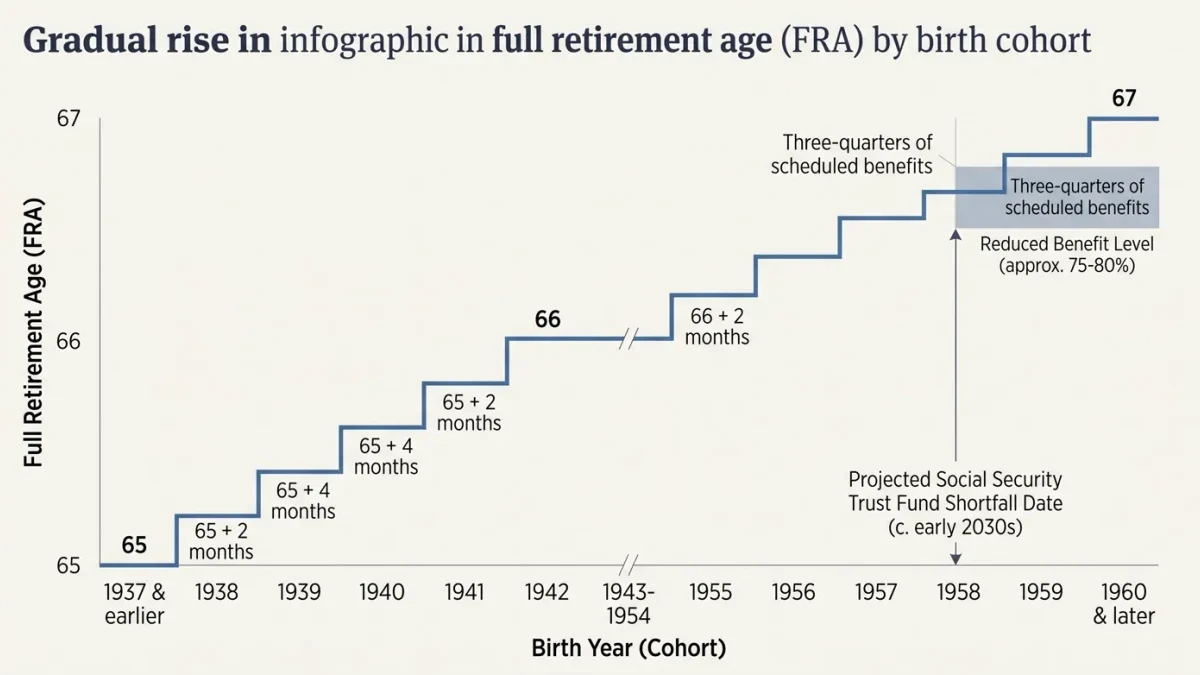
Social Security's combined trust funds face a projected shortfall early in the 2030s, at which point payroll-tax revenue would cover roughly three-quarters of scheduled benefits absent congressional action, per the trustees' 2025 annual report. The program's arithmetic — fewer workers per beneficiary than at its 1960 peak, per the Census and SSA data — drives the same menu of fixes every Congress: raise revenue, cut benefits, or some mix. Raising the retirement age is the benefit-cut lever, and it draws a clean line between the two camps.
What is the case for raising the age?
Advocates — fiscal hawks including the Manhattan Institute's analysts, the Committee for a Responsible Federal Budget, and the 2010 Simpson-Bowles commission whose plan indexed the age to longevity — make three arguments. Longevity: a worker turning 65 today can expect to live years longer than in 1983, when Congress last raised the age gradually to 67, and the commission's logic was that a share of those added years can fund work rather than retirement; life expectancy at 65 has risen by roughly three to four years since the program's early decades, per SSA actuarial tables. Fairness to the young: without action, scheduled benefits for current recipients continue while younger cohorts face the across-the-board cut the trustees project when reserves deplete — delaying a fix is itself a policy choice against the young. Design: the age need not move for physically demanding occupations if paired with a stronger, earlier eligibility for disability and hardship, the feature the Simpson-Bowles design included. Their strongest version: matching the benefit window to modern lifespans is the least-painful cut available — it phases over decades, spreads across cohorts, and preserves the program's structure rather than means-testing it into a welfare program.
Related stories: Should Supreme Court Justices Have Term Limits? Both Sides' Best Case · Should Puerto Rico Become a State? Both Sides' Best Case.
What is the case against?
Opponents — AARP, most congressional Democrats, and economists including former SSA deputy commissioner Jason Fichtner-adjacent critics of age-based cuts — answer point by point. Longevity gains are unequal: life expectancy at 65 for the top half of earners has risen far faster than for the bottom half — gap studies by Brookings and others show the divergence at several years — so a higher age is a bigger benefit cut precisely for those with shorter lives and harder jobs. Work feasibility: roughly a third of workers in their early 60s are in physically demanding jobs, per Bureau of Labor Statistics occupational data, and disability insurance cannot absorb them all — its own judges deny most claims from older manual workers without transferable skills. Benefit math: claiming at 70 under an age-69 full-retirement schedule versus 67 means a deeper early-claiming penalty, and most retirees already claim before full retirement age. Their strongest version: raising the age is a benefit cut averaging a month of income for each month added, landing hardest on those with the least wealth and the shortest lives — if a fix is needed, raising the payroll-tax cap is the option that does not shorten anyone's retirement.
What are the live proposals?
The current Congress's Social Security debate ranges from lifting or eliminating the payroll-tax cap above its roughly $176,100 taxable maximum, to changing the benefit formula's bend points, to gradual age increases to 69 or 70 with hardship exemptions. Every serious fiscal plan — CRFB's and the Peterson Foundation's compilations track them — pairs an age change with other measures, and no proposal has advanced in a chamber since the 1983 Greenspan Commission's bargain, which itself paired a higher age with revenue increases.
LMH News publishes information, not benefits or political advice. Positions are attributed to their named advocates; this primer presents each side at comparable length and endorses neither.